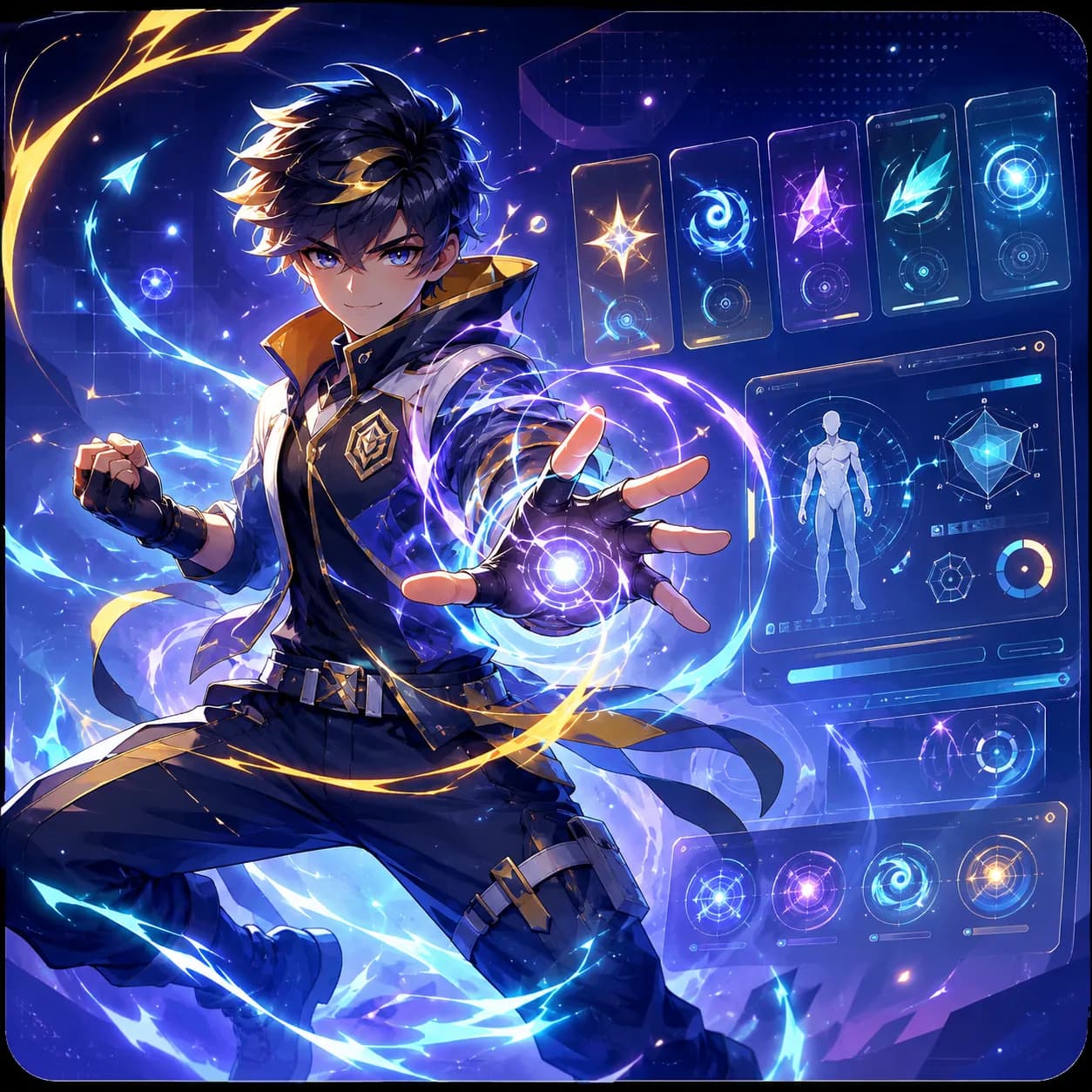
Create an original fan-made quirk with a coherent mechanism, clear activation rule, practical strengths, meaningful drawbacks, natural counters, special moves, awakening potential, and a shareable character profile.
Rule-based creative workshop
Choose how to build your quirk
● Runs in your browser
Generate a complete quirk immediately
Quick mode selects compatible mechanics, applications, costs, counters, moves, and an awakening. Every result receives a stable code.
Choose a mode and generate your first power.
Browser library
Saved powers and characters
Saved creations remain in this browser unless you export them.
No saved creations yet.
Generate a power, then choose “Save This Profile.”
Share the generator
Help another creator build a quirk
Send this custom MHA quirk generator to friends, writing groups, role-playing partners, or OC communities. Generated results also include their own stable sharing controls.
Send it to your community
Share the MHA Quirk Generator
Share the generator or a stable generated result without copying a long profile into every app.
What the tool does
A complete MHA quirk profile in one workflow
The generator runs through structured datasets, weighted choices, compatibility tags, exclusion rules, and a deterministic seed. Those rules keep each profile consistent from its activation method to its counterplay and growth path.
Fans may describe this type of tool as an MHA Quirk Generator, BNHA Quirk Generator, or Boku no Hero Academia Quirk Generator. BuildMyPower uses those phrases only to describe the same unofficial fan-creation purpose.
01The generator creates one central ability instead of stacking unrelated powers.
02Every result includes an activation method, target, range, duration, and control method.
03Every strong feature receives a practical cost, operating limit, or counter condition.
04Natural counters give opponents and writers believable ways to respond.
05Three special moves extend the same core mechanic in different situations.
06An awakening expands the original concept instead of replacing it with a new power.
07A stable result code lets the same generated quirk be reopened and shared.
08Custom mode controls classification, power family, role, range, strength, and tone.
09Quiz mode converts creative preferences into structured generator settings.
10Combination mode merges two power sources through one shared operating rule.
11Saved quirks stay in the current browser until they are exported or deleted.
12Balance and originality scores are creative estimates, not objective facts.
Four creation paths
Choose the right MHA quirk generator mode
The tool supports immediate random generation, detailed customization, a personality-based quiz, and hybrid power creation. Each mode uses the same validated rule engine, so the output still includes complete strengths, limitations, counters, moves, and character applications.
01
Quick random MHA quirk generator
Quick mode creates a full quirk without asking for settings. It is useful when you need fast inspiration for an original character, a fanfiction scene, a class roster, a role-playing character, or a creative writing exercise.
The mode does not select random sentences independently. It chooses a compatible mechanism first. It then builds the activation, effect, range, cost, counter, applications, special moves, and awakening around that central rule.
02
Custom MHA quirk generator
Custom mode gives you direct control over the type of ability you want. You can select a quirk classification, character role, power family, effective range, strength level, drawback severity, complexity, naming style, and creative tone.
This mode works well when you already know that your OC needs a rescue quirk, stealth ability, defensive power, villain-oriented effect, support skill, or unusual biological trait. Optional keywords guide the theme without replacing the compatibility rules.
03
MHA quirk personality quiz
The personality quiz asks how you prefer to solve problems, handle risk, work with others, plan actions, and approach conflict. Your answers map to structured traits such as role, range, complexity, tone, family, strength, and drawback preference.
This is a creative “what is my quirk?” experience. It is not a psychological test. The quiz does not diagnose personality, intelligence, mental health, or real-world ability.
04
Quirk combination generator
Combine mode blends two power sources into one hybrid ability. You can use broad power families, short descriptions, previously generated quirks, or saved results. You can also decide which source should dominate the combination.
The tool does not paste two unrelated abilities together. It finds a shared mechanism, creates one activation rule, inherits useful traits, adds a new interaction effect, and builds a limitation that fits the combined concept.
Custom builder controls
What each MHA quirk setting changes
Each control changes a different part of the generation process. The settings narrow compatible options instead of forcing unrelated traits into the result.
Alignment
Character direction
Choose hero, villain, vigilante, student, civilian, or neutral. Alignment affects applications, fighting style, team role, costume ideas, and character suitability.
Classification
How the quirk exists
Emitter focuses on producing or controlling an effect. Transformation temporarily changes the user. Mutant treats the trait as a persistent part of the body.
Primary role
What problem it solves
Select offense, defense, mobility, rescue, support, control, stealth, investigation, healing, or mixed use. The role guides applications and special moves.
Grounded results emphasize narrow, practical uses. Balanced results mix strengths and costs. Strong and extreme results receive heavier limits, recovery demands, or counters.
Drawback severity
How costly use becomes
Mild limits shape convenience. Meaningful limits change tactics. Severe and dangerous limits create major recovery needs, failure risks, or vulnerable states.
Effective range
Where the effect works
Contact, short, medium, long, and variable range settings affect targeting, accuracy, team position, counterplay, stamina cost, and combat usefulness.
Complexity
How many rules it needs
Simple powers are easy to explain. Advanced and unusual powers use more conditional logic but must still follow one understandable central mechanic.
Tone and name style
How the concept feels
Heroic, scientific, intimidating, mysterious, strange, elegant, chaotic, and practical tones shape vocabulary, naming patterns, visual effects, and presentation.
Custom keywords
Optional thematic guidance
Add a few short ideas such as “glass,” “echo,” “rescue,” or “night.” Keywords influence the output but do not override safety or compatibility rules.
Seed
Stable result identity
The result seed controls deterministic choices. The same validated seed and generator version can reconstruct the same quirk profile later.
Blend mode
Hybrid power dominance
Balanced blend gives both sources similar weight. Dominant modes favor one source. Unstable mutation and unexpected synthesis create less predictable interactions.
Instructions
How to use the MHA Quirk Generator
Choose a mode. Use Quick for an immediate result, Custom for direct control, Personality Quiz for preference-based settings, or Combine for a hybrid ability.
Set only the controls that matter. You do not need to fill every option. “Any” lets the engine choose the strongest compatible direction.
Generate the complete profile. The engine selects compatible mechanisms, effects, activation conditions, limits, counters, moves, and development paths.
Read the ability before the scores. The core mechanic explains what the quirk does. The scores summarize the result but do not replace the written rules.
Review the costs. Check the main drawback, warning side effect, counter, failure condition, environmental limit, overuse result, and recovery requirement.
Refine one section. Rename the quirk, replace a drawback, change a move set, adjust the fighting style, or modify the awakening without discarding the whole idea.
Use undo and redo. The current browser session keeps a result history so you can compare changes and restore the original version.
Save, share, or export it. Store the result locally, copy a stable link, share it directly to social platforms, download a card, or turn it into a character dossier.
Result anatomy
What every generated MHA quirk includes
A usable OC quirk needs more than a creative name. The result page explains the complete operating system of the ability and how it affects scenes, teamwork, training, and character development.
Identity and classification
Original quirk name
One-sentence summary
Emitter, Transformation, or Mutant classification
Power family and primary role
Stable result code
Core operating rules
Detailed core ability
Activation method
Valid target
Effective range
Duration, recharge, and control method
Strengths and practical uses
Primary and secondary strengths
Combat application
Rescue application
Civilian application
Team role
Drawbacks and counterplay
Main drawback
Physical or cognitive side effect
Environmental limitation
Natural counter and counter tactic
Failure and overuse consequences
Moves and development
Three named special moves
Training potential
Quirk awakening
Advanced mastery direction
Growth that preserves the original mechanic
Character compatibility
Hero suitability
Villain suitability
Vigilante suitability
Recommended fighting style
Costume or equipment consideration
Classification guide
Emitter, Transformation, and Mutant quirks
Classification tells you how the power exists and what kinds of operating rules it needs. It does not determine whether the quirk is strong, weak, heroic, or villainous.
E
Emitter
An Emitter result produces, transfers, controls, stores, redirects, or alters an effect beyond the user’s ordinary physical state. The profile normally needs a target rule, effective range, activation cue, control method, and resource cost.
An Emitter quirk may still affect the user’s body. The important feature is that the active effect is produced or directed rather than existing as a permanent body trait.
T
Transformation
A Transformation result temporarily changes the user’s body, material state, physical properties, or operating condition. The design needs a defined start, duration, warning sign, safe limit, recovery process, and return to normal.
A useful transformation should explain what improves and what becomes harder. Increased armor may reduce flexibility. Greater speed may reduce precision. A stronger form may consume a limited reserve.
M
Mutant
A Mutant result treats the ability as a persistent biological or structural trait. The trait affects ordinary life as well as combat. Training usually improves control, efficiency, coordination, sensory processing, or specialized applications.
A persistent trait still needs limitations. Size, sensitivity, environmental exposure, maintenance needs, restricted movement, or specialized equipment can create meaningful tradeoffs.
These explanations use original wording for creative guidance. They do not reproduce official reference text.
MHA quirk generator with drawbacks
How balanced quirks create better stories
A balanced quirk can still be powerful. The important question is what the character must decide, prepare, risk, conserve, or give up when using it.
Range, duration, force, target count, versatility, healing, protection, mobility, and low activation effort increase the power budget. Cooldowns, finite resources, environmental dependence, preparation time, accuracy difficulty, vulnerable states, side effects, and natural counters reduce it.
A cosmetic weakness does not balance an extreme ability. “The user becomes tired” only matters when the profile defines what triggers fatigue, what fails first, how the warning appears, how long recovery takes, and what happens when the warning is ignored.
The balance action preserves the core idea. It may narrow range, reduce duration, increase recharge time, strengthen a counter, limit target count, or make the drawback affect actual decisions.
Useful balance pattern
Strength
Stores vibration from impacts and releases it as a controlled shockwave.
Choice
The user must decide whether to spend the reserve on defense, movement, or one strong release.
Warning
Joint tremors show that the safe storage ceiling is close.
Counter
Slow pressure and soft damping materials provide little useful vibration.
Recovery
The reserve must be discharged gradually before precise movement returns.
Every interactive feature explained
Refine, combine, save, and develop your quirk
The result is the beginning of the workflow. BuildMyPower lets you improve one field at a time, compare versions, create a character, and export the finished concept in several formats.
Quirk Workshop
Refine one part without losing the whole result
Field-level rerolls keep the central ability intact. You can rename the quirk, replace the activation method, strengthen the drawback, change the side effect, find a better counter, regenerate special moves, revise the awakening, or improve civilian use.
Make More Balanced identifies the main imbalance and adjusts practical rules.
Make It Stronger increases capability while preserving a meaningful cost.
Make It More Grounded narrows extreme effects into practical applications.
Improve Rescue or Combat Use changes applications rather than replacing the mechanic.
Make It Stranger or Scientific changes presentation and logic while retaining continuity.
Undo, redo, and history
Compare multiple versions safely
Every workshop change creates a new version in the current session. Undo returns to an earlier profile. Redo restores a later change. Restore Original returns to the first generated version. Duplicate and Modify creates a separate branch for experimentation.
This is useful when you want to compare two drawbacks, test a more grounded version, or preserve a favorite move set before changing the awakening.
Saving and collections
Keep powers and character dossiers in your browser
Saved profiles remain in local browser storage. You can rename a saved result, mark it as a favorite, duplicate it, place it in a collection, export the full library, import a previous library file, or delete local data.
No account is required. Browser storage is convenient but not permanent. Export important creations before clearing browser data, changing devices, or resetting the browser.
Sharing and exports
Share a stable result or download the profile
Copy Share Link creates a URL that reconstructs the same validated result. Social buttons can send that link directly to Facebook, X, LinkedIn, Reddit, WhatsApp, Telegram, Pinterest, email, or the device sharing menu.
You can also copy plain text, copy a formatted profile, download landscape or portrait PNG cards, create a PDF, export CSV or JSON, and print the result. The share card uses original BuildMyPower graphics rather than franchise artwork.
Creative scoring guide
How the quirk scores should be read
The score bars summarize the generated rules. They help you compare versions of the same concept. They do not measure official canon strength or determine which character would win a fight.
Power
Maximum effect
Estimates the result’s potential force, protection, healing, disruption, or scene-changing influence under favorable conditions.
Range
Operating distance
Reflects how far the quirk can affect targets and how much distance changes accuracy, cost, or control.
Control
Precision and reliability
Estimates how accurately the user can start, stop, aim, shape, or limit the effect.
Versatility
Number of useful applications
Considers combat, rescue, support, mobility, investigation, civilian use, and teamwork without counting unrelated powers.
Stamina cost
Ongoing resource demand
Estimates how quickly activation, sustained use, repeated use, or recovery consumes the user’s safe operating capacity.
Drawback severity
Practical consequence
Measures how strongly the limitation affects decisions, timing, safety, recovery, vulnerability, or failure risk.
Overall balance
Strength-to-cost relationship
Compares the estimated benefits with activation effort, counters, range, duration, stamina, side effects, and recovery.
Originality
Combination distinctiveness
Estimates how unusual the combined mechanism, activation, limitation, application, and presentation are within the local generator dataset.
Important limit
Not an official ranking
Scores are internal creative-writing estimates. They cannot prove uniqueness or compare a fan-made quirk with official characters objectively.
MHA OC quirk generator
Build a full character from the generated ability
The Character Dossier turns the quirk into a broader original-character framework. You can choose a hero, villain, vigilante, student, civilian, or undecided role. You can also provide your own character name.
The dossier suggests a hero or villain name, personality traits, personal strengths, flaws, motivation, fear, goal, backstory prompt, costume concept, equipment, combat style, rescue style, training priorities, team role, rival dynamic, mentor dynamic, growth arc, and three story prompts.
The dossier uses the generated quirk as its foundation. A mobility quirk should influence fighting style and rescue work. A sensory quirk should influence investigation and overload risks. A persistent mutant trait should affect ordinary life and costume design.
Use the dossier as a planning aid. Revise the character’s identity, culture, relationships, voice, history, and emotional arc so the finished OC feels personal rather than automatically assembled.
Design principles
How to create a good original character power
01
Start with one central mechanic
Describe what changes and how it changes in one clear sentence. Special moves should be applications of that rule.
02
Define the activation
Contact, movement, breath, sight, equipment, rhythm, concentration, or preparation gives the ability a readable beginning.
03
Give it a useful strength
The ability should solve a recognizable problem in combat, rescue, investigation, support, mobility, or ordinary life.
04
Add a meaningful cost
The cost should change decisions. It may limit duration, range, reserve, precision, movement, target count, or safe frequency.
05
Create a natural counter
A counter gives other characters a believable response and prevents every scene from ending the same way.
06
Plan the training path
Training should improve control, efficiency, teamwork, judgment, or application. It should not simply erase every weakness.
07
Leave room for story tension
A good ability creates difficult choices, misunderstandings, teamwork problems, failures, and moments of earned mastery.
Original worked examples
Three balanced quirk concepts
These examples show how a clear mechanic, practical limitation, natural counter, and focused growth path work together.
Hero-oriented
Resonance Vault
Ability: Stores part of a received vibration and releases it through a directed strike, stomp, or shockwave.
Activation: The user must maintain contact with the vibrating surface or object long enough to absorb a usable pattern.
Limit: Stored vibration stresses joints and must be released before precise movement returns.
Counter: Soft materials and slow loading create little usable vibration.
Growth: Training improves staged release, movement control, and rescue cushioning rather than unlimited storage.
Support and rescue
Load Lattice
Ability: Draws temporary support lines across a damaged structure and distributes weight among them.
Activation: The user must touch two stable anchor points and understand the direction of the load.
Limit: The user must remain planted and can support only a fixed total load.
Counter: Moving an anchor point or adding a sudden unmeasured load collapses the lattice.
Growth: Mastery allows moving anchors, clearer load sensing, and safer coordination with rescue teams.
Antagonist-oriented
Attention Static
Ability: Creates harmless sensory cues that repeatedly pull attention away from the user’s real movement.
Activation: The user must observe the target long enough to identify which type of cue attracts their attention.
Limit: It cannot control decisions, and observers adapt when the same cue repeats.
Counter: Multiple observers, recorded footage, and disciplined communication reveal the pattern.
Growth: The awakening coordinates different cue types without increasing direct mental influence.
Fanfiction and role-playing uses
How to use a generated quirk in an original story
A generated profile can support an OC, fanfiction outline, role-playing campaign, classroom roster, rival concept, rescue scenario, villain encounter, or worldbuilding exercise.
Original character planning
Connect the quirk’s limitation to personality and daily life. A character who depends on environmental sound will behave differently in silence. A user with a visible mutant trait may need specialized clothing or equipment.
Fanfiction conflict
Use the natural counter and failure condition to create scenes that cannot be solved by raw output. Let teamwork, preparation, information, and judgment matter.
Training progression
Build training around control, efficiency, safe limits, rescue use, timing, and decision-making. Do not remove every drawback as soon as the character improves.
Role-playing balance
Turn range, duration, recharge, and resource limits into clear table rules. Agree on what the power cannot do before the campaign begins.
Hero or villain contrast
The same mechanism can support different roles. A material-binding power may stabilize rubble for rescue or restrict movement for an antagonist. Motivation and use matter as much as the effect.
Worldbuilding consistency
Decide how similar powers affect medicine, construction, law, education, equipment, accessibility, employment, and public safety within your fictional setting.
For canonical background about the series premise and official setting, consult the official My Hero Academia anime introduction. BuildMyPower generates independent fan-made concepts and does not define or extend official canon.
Avoid these problems
Common quirk-building mistakes
Unlimited output: A power with no reserve, cooldown, range, target limit, or environmental condition removes important choices.
Cosmetic drawbacks: A vague headache does not matter unless it changes accuracy, timing, behavior, safety, or recovery.
Contradictory rules: The profile should not call an effect contact-only and long-range at the same time.
Unrelated abilities: Three separate powers are harder to understand than three applications of one mechanic.
No activation condition: Readers need to know when the power begins, what the user must do, and what can interrupt it.
No counter: Every useful power needs at least one practical response that another character can discover or prepare.
No non-combat use: Rescue and civilian applications make the ability feel connected to a larger world.
No growth path: Training should have a direction beyond simply increasing damage or removing limitations.
Overloaded awakening: An awakening should expand the same mechanic rather than grant an unrelated second power.
Direct copying: Change the mechanism, cost, application, presentation, and character meaning rather than renaming an existing ability.
Questions and answers
MHA Quirk Generator FAQ
What is an MHA quirk generator?
An MHA quirk generator creates an original fan-made ability concept with a classification, clear mechanic, strengths, drawbacks, counters, and development ideas.
How does this quirk generator build results?
BuildMyPower uses local structured datasets, compatibility rules, weighted choices, and a deterministic result seed. Those rules keep the activation, strengths, drawbacks, counters, and development path connected.
Can I create a balanced quirk?
Yes. Every result receives power, control, stamina, drawback, and balance estimates. The balance workshop can adjust the result while preserving its central mechanic.
Can I choose an MHA quirk type?
Yes. Custom mode lets you choose Emitter, Transformation, Mutant, or Any. The selected type limits which mechanisms and activation patterns the generator can combine.
Can I generate a quirk from my personality?
Yes. The personality quiz maps your answers to power families, roles, range, complexity, tone, strength, and drawback preferences. It is a creative quiz, not a psychological assessment.
Can I combine two quirks?
Yes. Combination mode blends two saved powers, broad power families, or short descriptions. It creates one shared mechanism, activation, limitation, counter, and growth path instead of joining two unrelated descriptions.
Can I save my generated quirk?
Yes. Saved powers and character dossiers stay in this browser. You can organize them into collections, mark favorites, export the saved library, or clear all local data.
Can I share the same result with someone else?
Yes. The share link stores a validated result representation so another browser can reconstruct the same profile. Personal quiz answers are not placed in the shared link.
Are generated quirks official?
No. Every result is unofficial fan-made creative content. BuildMyPower is not affiliated with, endorsed by, or sponsored by the creators, publishers, studios, or licensors of My Hero Academia.
Can I use a result for an original character?
Yes. You can adapt a result for an original character, story, role-playing campaign, or fan project. Review and revise it because the generator cannot guarantee that no similar idea has ever existed.
Why does every quirk have a drawback?
A meaningful drawback creates choices, training goals, counters, and story tension. It also stops a strong power from solving every problem without cost or preparation.
How does the balance score work?
The balance score compares estimated power, range, versatility, stamina cost, activation effort, drawback severity, and counter strength. It is an internal creative-writing estimate, not an objective measurement.
Sources and references
Official My Hero Academia anime website — official franchise and setting context.
Schema.org and Google Search Central — structured-data and search implementation guidance.
BuildMyPower uses original explanatory wording and does not imply affiliation with these sources.